

"Am I in menopause?"
I hear this all the time, and the words get used so loosely that it's no wonder people are confused. Your friend says she's in menopause, and she's still having periods. Your doctor says you're too young. The internet says everything is hormones.
Here's the simple version: perimenopause is the transition, and menopause is the day you've gone a full year without a period. Let's sort out what that means for you.
Quick summary: what you need to know
- Perimenopause is the transition. Hormones are changing and you're still having periods, even if they've become unpredictable. At AgeWell, it starts when you have symptoms from those hormonal shifts.
- Menopause is one point in time. It's reached after 12 months in a row without a period.
- Postmenopause is everything after that. It lasts the rest of your life.
- The average age of menopause is about 51 to 52. Textbooks place the start of perimenopause in the mid-40s. In my experience, symptoms often begin around 35.
- Care can help at every stage. Your options depend on your symptoms, history, and goals.
What's the difference between perimenopause and menopause?
The difference is that perimenopause is the years of hormone change leading up to your last period, and menopause is the point when you've gone 12 months in a row without one. If you're still having periods, even irregular ones, you're not in menopause yet.
| Perimenopause | Menopause | Postmenopause | |
|---|---|---|---|
| What it is | The transition | One point in time | The years after |
| Periods | Still happening, and may change | None for 12 months | None |
| Typical timing | Textbooks say mid-40s; in my experience, around 35 | Average age about 51 to 52 | The rest of your life |
| Hormones | Progesterone falling, estrogen swinging | Low | Low |
| Common concerns | Sleep, mood, periods, hot flashes | Hot flashes, sleep, dryness | Bone, heart, vaginal, and bladder health |
What happens to your hormones in each stage?
During perimenopause, your hormones don't fall in a straight line. Progesterone drops first and tends to slide down over time, and estrogen can go up and down from one week to the next. Those swings can rock your world.
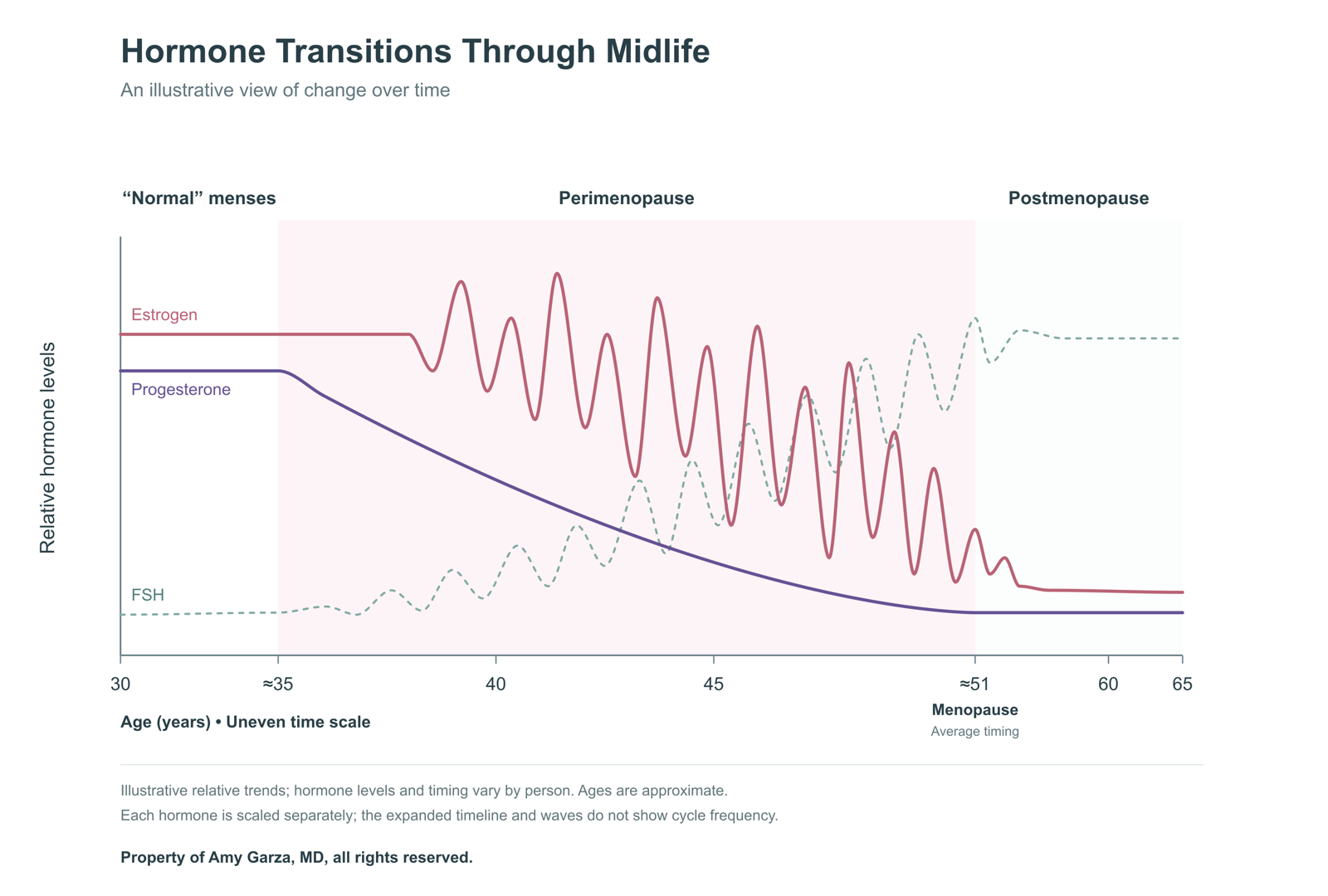
Estrogen tends to be stimulating, and progesterone tends to be calming. When the usual gap between them changes, you can feel overstimulated or lose your sense of calm. That's why so many women notice sleep and anxiety first.
This is also why AgeWell defines perimenopause a little differently. The standard definition is tied to when estrogen starts to change. We define it as when you experience symptoms from the hormonal shifts of the midlife transition, because your progesterone may have been falling for years by then.
By menopause, your ovaries have largely stopped making estrogen and progesterone, and testosterone is lower too. Levels are low, and they're generally steadier. Some women feel better when the swinging stops. Others find that dryness, bladder changes, and sleep problems become bigger concerns.
Do the symptoms feel different?
Many symptoms overlap, and the pattern can be different. Perimenopause often feels unpredictable: good days, bad days, and two weeks of the month that don't feel like the other two. After menopause, hot flashes often ease over time for many women, and dryness and urinary changes may stick around or show up.
Bone and heart health also move up the list after menopause, because the risks of osteoporosis and heart disease go up with low estrogen. A lot of these things start in midlife, and that's when we can take control of them.
How do I know which stage I'm in?
Your periods are usually the best guide. If you're still having them and your symptoms have changed, you may be in perimenopause. If it has been 12 months since your last period, you've reached menopause.
It can get tricky if you've had a hysterectomy, an ablation, or an IUD and don't have periods to go by. Perimenopause is a clinical diagnosis, so we don't need labs to make it. Labs such as FSH and estradiol can help in some situations, and they aren't the whole answer, because levels can change from week to week. That's a good time to see someone who does this every day.
If you've gone without periods and then have any bleeding, please get it checked.
Does the stage change treatment?
Yes, your stage can change what we consider. In perimenopause, we may start with progesterone, depending on your symptoms and history. Around and after menopause, estrogen often becomes part of the conversation too. Your history, your goals, and your risks all matter, and the choice is yours.
Hormones aren't the whole plan. Sleep, strength training, protein, and stress all matter at every stage. Learn more about hormone therapy for women, read the first signs of perimenopause, or see how we care for women's hormone health at AgeWell, a physician-led midlife medicine practice for men and women in Amarillo, Texas.
Frequently asked questions
Can I be in menopause and still have periods?
No. Menopause means 12 months in a row without a period. If you're having periods, you're likely still in perimenopause if your hormones are changing.
How long does perimenopause last?
It averages about four years, and it can last longer. Some women have it for only a few months.
How long do symptoms last after menopause?
It varies. Many symptoms ease, and some can last for years. Vaginal and bladder changes may need ongoing care.
Can I still get pregnant in perimenopause?
Yes, pregnancy can still happen until you've reached menopause. Talk with your clinician about contraception.
Do men go through menopause?
Not in the same way. Testosterone usually falls gradually over years. Our men's hormone health page explains what can change.
See if AgeWell is right for you
This article is for education and isn't a substitute for personalized medical advice. Talk with your clinician about your own situation. If you have severe or urgent symptoms, seek emergency care.
Sources
- Cleveland Clinic: Menopause
- Cleveland Clinic: Perimenopause
- The Menopause Society: Perimenopause


