

"Should I see an endocrinologist?"
People ask me this all the time, and plenty of people searching for an endocrinologist in Amarillo end up on our website.
Sometimes an endocrinologist is exactly who you need. Sometimes a different kind of doctor is a better fit for what's bothering you. And sometimes the answer is both.
So let me be clear up front: I'm not an endocrinologist. I'm a board-certified anesthesiologist, I was certified in age management medicine in 2014, and I've prescribed hormones for more than a decade. Here's how I'd think about the choice if I were in your shoes.
Quick summary: what you need to know
- Endocrinologists are specialists in hormone diseases, like diabetes, thyroid disease, and pituitary, adrenal, and bone disorders.
- "Hormone doctor" isn't an official specialty. It can mean an endocrinologist, a gynecologist, a urologist, a family doctor, or a physician who focuses on midlife hormone care.
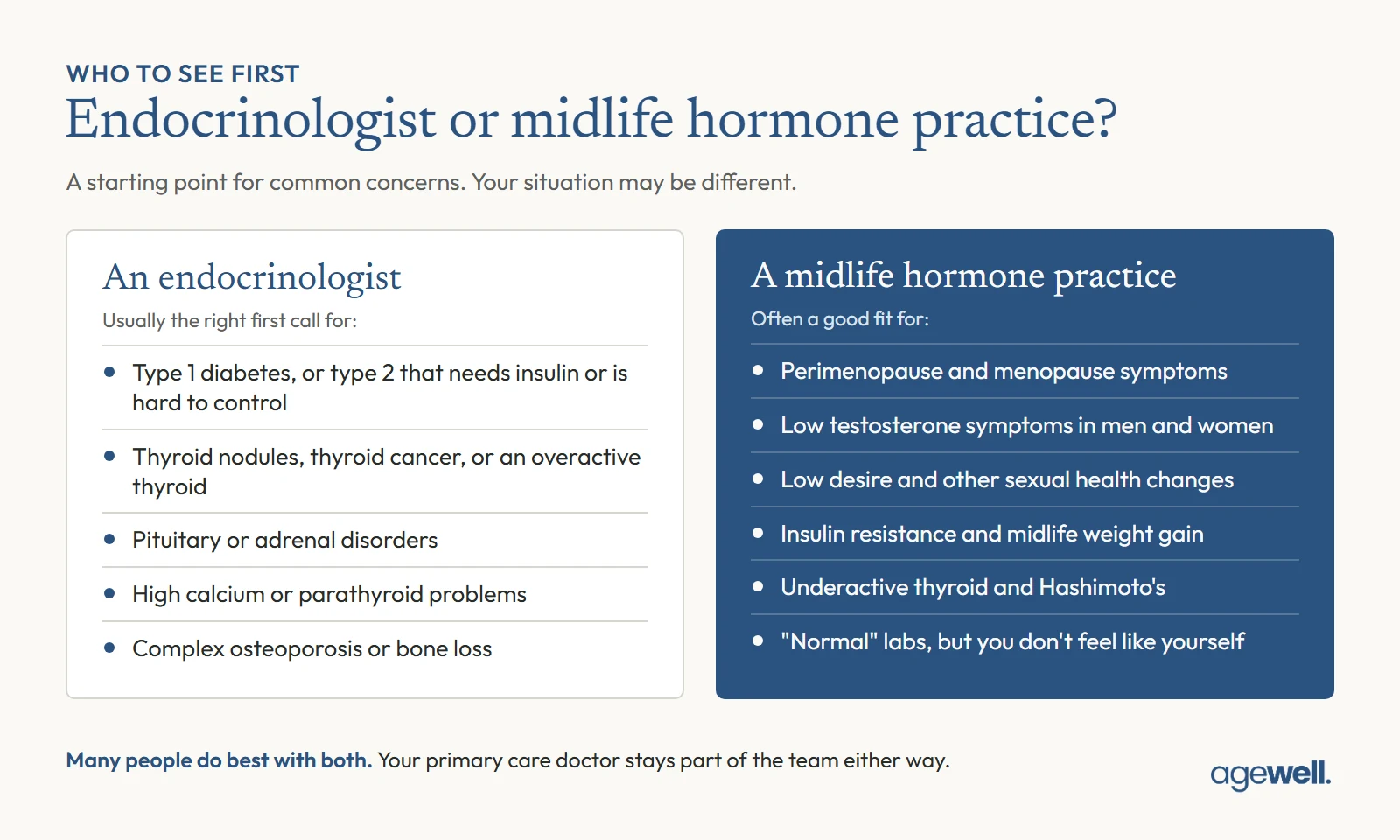
- See an endocrinologist first for type 1 diabetes, hard-to-control type 2 diabetes, thyroid nodules or cancer, an overactive thyroid, or pituitary, adrenal, or calcium problems.
- A midlife hormone practice is often a good fit for perimenopause, menopause, low testosterone, low desire, and insulin resistance.
- Wherever you go, ask about their training, how they decide on treatment, and how they'll follow you over time.
What does an endocrinologist do?
An endocrinologist is a doctor who specializes in the endocrine system, the glands that make your hormones. After medical school, most complete a residency in internal medicine and then two to three more years of fellowship training in endocrinology, diabetes, and metabolism.
Endocrinologists diagnose and treat conditions like:
- Type 1 and type 2 diabetes
- Thyroid disease, including nodules, thyroid cancer, and an overactive or underactive thyroid
- Pituitary and adrenal disorders, like Cushing's syndrome
- Calcium and bone conditions, like parathyroid problems and osteoporosis
- Reproductive hormone conditions, like low testosterone (hypogonadism) and PCOS
- Metabolic conditions, like obesity and metabolic syndrome
They're also experts in specialized hormone testing, including tests that stimulate or suppress a gland to see how it responds.
What is a hormone doctor?
"Hormone doctor" isn't a board-certified specialty. It's a description people use, and it can mean very different things:
- An endocrinologist
- A gynecologist who focuses on perimenopause and menopause
- A urologist who treats low testosterone
- A family or internal medicine doctor with extra training in hormone care
- A physician or nurse practitioner who focuses on midlife hormone and metabolic health
That range is why it's worth asking anyone, including us, about their training and experience. Groups like The Menopause Society offer additional education and certification in menopause care.
What's the difference between an endocrinologist and a hormone doctor?
Here's the simple version: focus.
Endocrinologists are trained to find and treat disease in the glands themselves: a thyroid nodule, a pituitary tumor, diabetes that's hard to control. A midlife hormone practice usually focuses on how hormone changes in your 40s, 50s, and 60s affect how you feel and function: hot flashes, poor sleep, low desire, low energy, and weight around the middle.
There's real overlap. Some endocrinologists treat menopause and low testosterone every day, and some don't. The same is true of gynecologists, urologists, and family doctors. The best fit depends on what's going on and on the person you'll see.
When should you see an endocrinologist?
I'd start with an endocrinologist, or ask your primary care doctor for a referral, if you have:
- Type 1 diabetes, or type 2 diabetes that needs insulin or is hard to control
- A lump in your neck, or a thyroid nodule found on imaging
- An overactive thyroid (hyperthyroidism), such as Graves' disease
- A known or suspected pituitary or adrenal problem
- High calcium on your blood work, or a parathyroid problem
- Osteoporosis that's severe or isn't improving with treatment
- Hormone levels that are very abnormal, or that don't fit together in a way that makes sense
At AgeWell, when we find something that belongs with an endocrinologist, we refer you. We do that for an overactive thyroid, thyroid nodules, and thyroid cancer, for example.
Should I see an endocrinologist for menopause?
You can, and some endocrinologists are excellent menopause doctors. But many focus mostly on diabetes and thyroid disease. Menopause care is also commonly provided by gynecologists, primary care doctors, and practices that focus on midlife health.
What matters more than the title is whether your doctor stays current on hormone therapy. For healthy women with bothersome symptoms who are under 60 or within 10 years of menopause, The Menopause Society says the benefits of hormone therapy generally outweigh the risks.
If you've been told hormones aren't right for you, it's fair to ask for the reasoning, and a second opinion is always okay.
And if you've been told you're "not in perimenopause" because your labs looked normal, know that perimenopause is usually diagnosed by your symptoms and your cycle, not by one blood test. Normal just means common. Symptoms are data.
Read can a blood test diagnose perimenopause? and our midlife guide to HRT for women.
Do endocrinologists treat low testosterone?
Yes. Low testosterone in men, called hypogonadism, is part of endocrinology training, and many endocrinologists treat it. Urologists and other physicians treat it too.
How a doctor decides to treat it varies. So ask what they look at before they prescribe: your symptoms, your history, your goals, your labs, and what's been tried before. You deserve a clear explanation of your numbers, your symptoms, and your options, including the risks.
Read low testosterone symptoms in men and what a normal testosterone level is.
For women, testosterone is a different conversation. It can help some women with low desire after menopause, but there's no FDA-approved testosterone product for women in the U.S., so it's prescribed off-label, and fewer doctors offer it. Read testosterone for women: what we know.
Do I need an endocrinologist for thyroid problems?
It depends on the problem. Many people with an underactive thyroid (hypothyroidism) or Hashimoto's are treated by their primary care doctor or another physician, and we treat both at AgeWell. We check a full thyroid panel at your first visit.
For an overactive thyroid, thyroid nodules, or thyroid cancer, we refer you to an endocrinologist. See thyroid care at AgeWell.
Do I need a referral to see an endocrinologist?
Often, yes. Many endocrinology offices ask for a referral from your primary care doctor, and some insurance plans require one, so check with the office and your plan.
Endocrinologists are in short supply in many parts of the country, and new-patient waits can be long, so it helps to start the referral early.
AgeWell doesn't bill insurance, and you don't need a referral to see us. You can start with a free conversation to see if we're the right fit.
How do I choose the right doctor in Amarillo?
Whether you're looking for an endocrinologist or a hormone doctor in Amarillo, the same questions help:
- What's your training, and how much of your practice is hormone care?
- What do you look at before you prescribe: my symptoms, my history, my labs, or all three?
- How often will you see me, and how will we know if it's working?
- What happens if I don't feel better?
- How do you work with my primary care doctor?
Our article on how to choose a hormone doctor goes deeper, and our free Hormone Care Quality Checklist has 15 questions you can bring to any visit.
If you need an endocrinologist, your primary care doctor can refer you to one here in Amarillo.
Where does AgeWell fit?
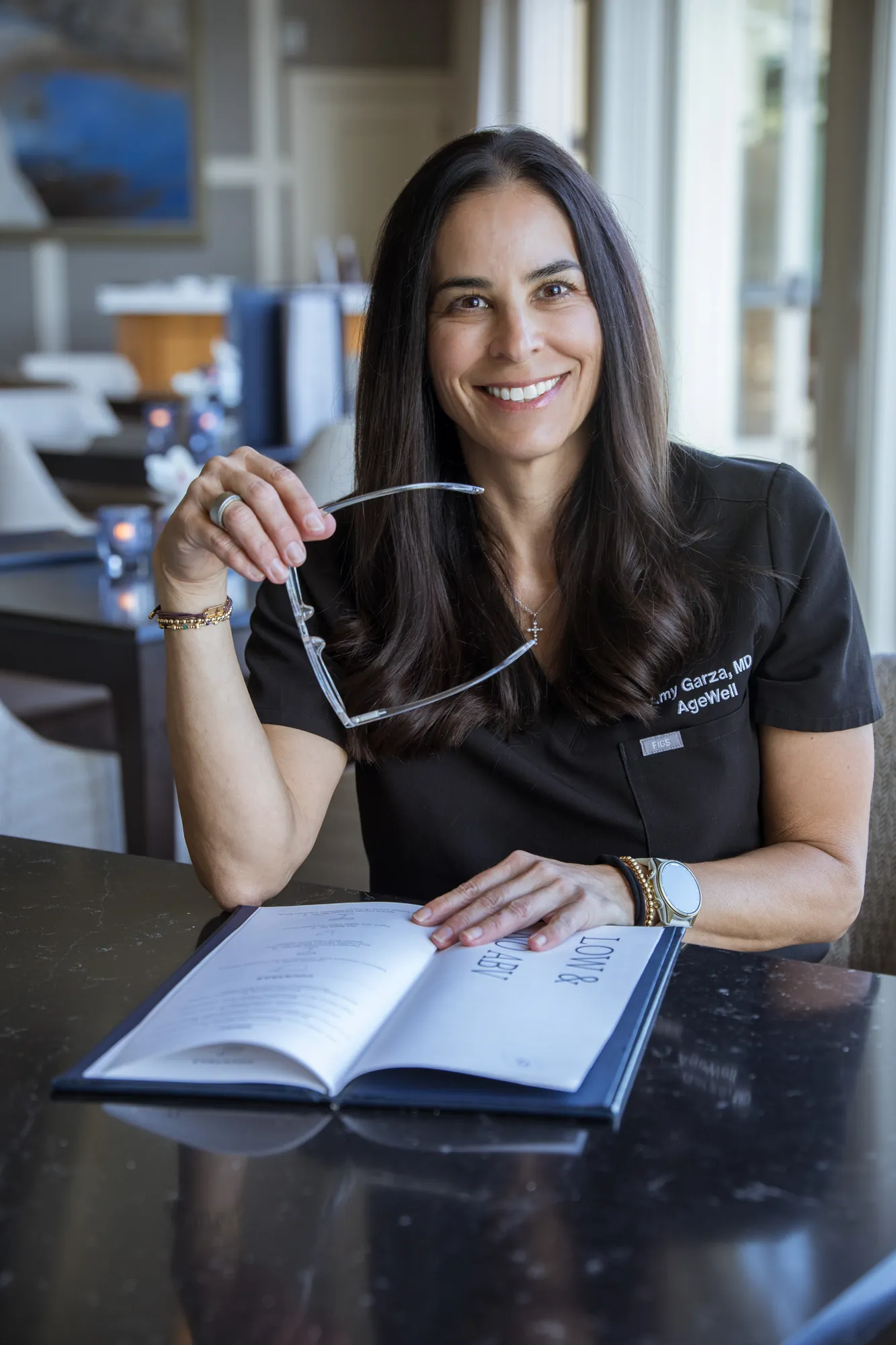
AgeWell is a physician-led midlife medicine practice for men and women in Amarillo, Texas. We focus on hormone, metabolic, and sexual health, usually for people in their 40s to 60s.
I'm a member of the Age Management Medicine Group, the American Academy of Anti-Aging Medicine (A4M), The Menopause Society, the International Society for the Study of Women's Sexual Health (ISSWSH), and the Androgen Society.
I've trained every AgeWell provider in the way we practice. Care starts with a free conversation, then a Foundational Assessment with comprehensive labs and an unhurried visit.
Two things can be true at once. You can have an endocrinologist and a midlife hormone practice on your team. We work alongside your primary care doctor, and alongside your endocrinologist if you have one. If something you need belongs with a specialist, we'll tell you.
Patients also travel to Amarillo to see us.
Frequently asked questions
Is an endocrinologist a hormone doctor?
Yes. An endocrinologist is a board-certified specialist in hormone disorders. But not every hormone doctor is an endocrinologist.
Can a gynecologist prescribe hormone therapy?
Yes. Gynecologists commonly prescribe menopause hormone therapy, and many are very experienced with it.
Who treats PCOS, an endocrinologist or a gynecologist?
Both commonly do. If you're trying to get pregnant, a reproductive endocrinologist, a gynecologist with additional fertility training, may be the best fit.
Can an endocrinologist help with weight loss?
Many do, especially when weight is tied to diabetes, insulin resistance, or another hormone condition. Some physicians also specialize in obesity medicine.
Is AgeWell an endocrinology practice?
No. AgeWell is a midlife medicine practice. We treat hormone, metabolic, and sexual health concerns, and we refer to endocrinologists when that's the right fit.
Feeling better is where we start. See if AgeWell is right for you
This article is for education and isn't a substitute for personalized medical advice. Talk with your clinician about your own situation. If you have severe or urgent symptoms, seek emergency care.
Sources
- Cleveland Clinic: Endocrinologist: What They Do & When To See One
- The Menopause Society: The 2022 hormone therapy position statement. Menopause, 2022.
- The Menopause Society: Choosing a Healthcare Practitioner
- Davis SR, et al. Global consensus position statement on the use of testosterone therapy for women. Journal of Clinical Endocrinology & Metabolism, 2019.
- Vigersky RA, et al. The clinical endocrinology workforce: current status and future projections of supply and demand. Journal of Clinical Endocrinology & Metabolism, 2014.